Origins & development
How genetic, developmental and environmental systems converge across the lifespan.
Independent research project
AuDHD Origins & Biology Research investigates the biological, developmental, hormonal, metabolic and evolutionary dimensions of co-occurring autism and ADHD—and translates emerging evidence into clear, traceable research maps.
Public evidence maps stay open. Membership funds deeper reports, multilingual guides and future research tools.
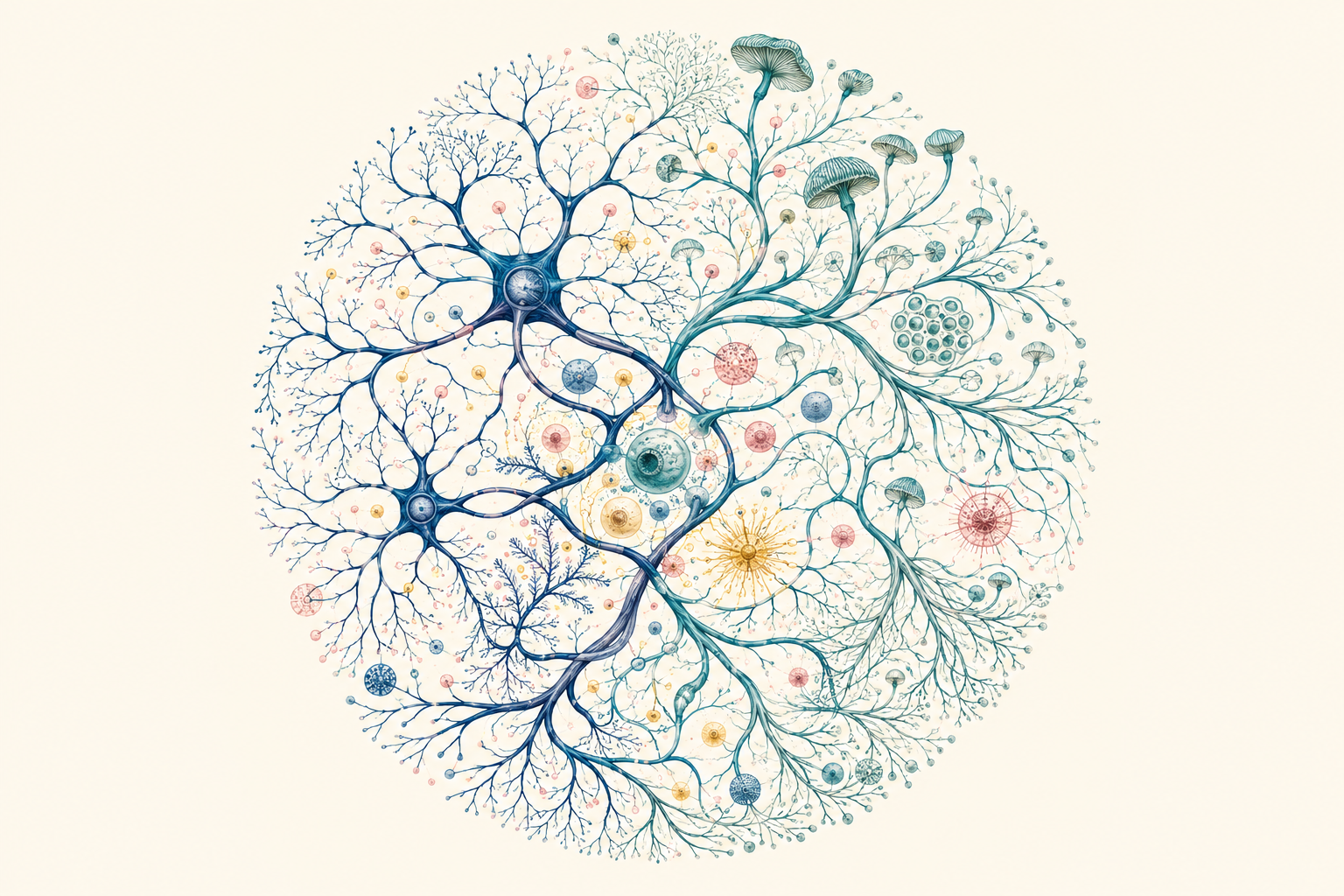
The research proposition
AuDHD is commonly split into two diagnostic categories. This project asks what becomes visible when it is investigated as one interacting developmental and biological system.
Research territory
Five connected lines of inquiry, designed to evolve as the evidence base and community questions develop.
How genetic, developmental and environmental systems converge across the lifespan.
How endocrine transitions may alter cognition, sensory processing and medication response.
How energy regulation, autonomic function and whole-body biology shape experience.
Why treatment response may vary across integrated autistic and ADHD profiles.
Which adaptive patterns and trade-offs may sit behind AuDHD traits.
Living roadmap
Many people report meaningful changes across menstrual, perimenopausal and menopausal transitions, while the evidence remains fragmented across disciplines.
Energy regulation, interoception, sleep and stress physiology are often studied separately, although they may form interacting systems.
Overlapping outward signs can conceal different mechanisms, contexts and support needs.
Evidence without false certainty
Evidence status and research stage are separate. A published piece can still describe an emerging finding or a hypothesis.
Consistent evidence or authoritative consensus.
Multiple credible sources; important limits remain.
Early, mixed or rapidly developing evidence.
A proposed explanation requiring further testing.
Recurring lived reports, not established evidence.
For clinicians
Concise briefs and consultation tools that preserve uncertainty, make mechanisms traceable and keep lived experience in view.
Explore clinician resourcesClear evidence status
02Full source trails
03Multilingual formats
04Designed for conversation
Fund independent inquiry
Support evidence mapping outside institutional silos and receive deeper research reports, practical guides, member briefings and early access to participatory research tools.